 NextEraSolutions
iOS app development: iPhone apps in Swift, including Screen Time, push notifications and App Store review
Next Era Solutions builds iPhone apps and takes them through App Store review. One of them is a Screen Time app we released on the App Store. Another is the iOS app of a Ukrainian legal-services firm, which its clients use on iPhone and Android.
Is this you?
Your app needs something only an iPhone can do.
Screen Time controls, for example. Apple guards these features with extra permissions and its own approval.
Most of your customers use iPhones.
In the UK, iOS had 51.5% of mobile web traffic in August 2026, and Android 48.5% (StatCounter, page views). [TEAM SUPPLIES: re-check at publish, https://gs.statcounter.com/os-market-share/mobile/united-kingdom. If Android leads in September, reword this heading to “About half of UK mobile users are on iPhone”]
Your app must ask for sensitive permissions, and people say no.
Notifications, Screen Time, location. iOS shows its notification prompt only once (Apple), so what comes before that prompt matters.
Your Android app is ahead of your iPhone app.
Or you have a web product and want the iPhone app first.
What you get
- An iPhone app in Swift, with the code in a Git repository that is yours: often from day one, or, on some MVPs, transferred to you after we build, as agreed in the contract. The rights pass to you as each invoice is paid.
- The App Store side, done with you: App Store Connect set-up, the privacy details Apple asks for, and review notes that explain any sensitive permission.
- Permission screens that explain first. Rethought tells people why it needs Screen Time access before iOS shows its own request.
- Push notifications that open the right screen. Merezha Prava's notifications link straight to the stage of the client's case.
- Weekly progress you can check against the plan.
Rethought
Our role: we built the app and released it on the App Store.
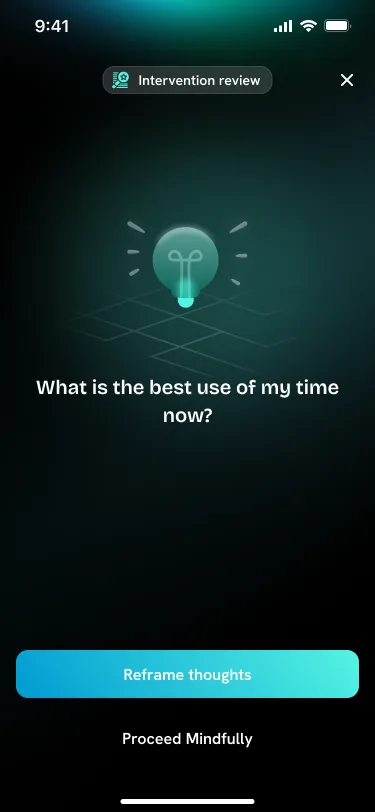
Rethought (Switzerland) helps people pause before they open an app that distracts them. It doesn't hard-block. It asks a short question, then the person decides to continue or stop. Live on the App Store since 23 June 2026; needs iOS 16 or later (App Store listing). [TEAM SUPPLIES: re-check the App Store listing at publish]
Read the Rethought case →- 3 intervention steps: open a distracting app, answer a short prompt, then continue or pause
- Screen Time access explained before iOS asks for it
- Built on Apple's Screen Time frameworks. Family Controls asks for the person's permission. Managed Settings puts a shield screen over the apps they chose. Device Activity runs the schedules. [TEAM SUPPLIES (engineer): confirm before publishing]
- Three app extensions that iOS runs itself: one reacts to schedules, one draws the shield screen, and one handles taps on its buttons. [TEAM SUPPLIES (engineer): confirm before publishing]
- The screens are written once in Flutter; everything that touches Screen Time is Swift. [TEAM SUPPLIES (engineer): confirm the Swift part (publish gate 2)]
More iOS work
Merezha Prava · Ukraine
Our role: discovery and design, the native iOS and Android apps, the Laravel backend and the web admin.
Clients of a law firm follow their case, upload documents and get push updates that open the right case stage. Sign-in is by phone number with an SMS code. The apps are published under the client's own developer account. On the App Store since April 2024. Its listing in Ukraine shows 4.8 out of 5 from 504 ratings: the client's public figure, checked on 23 September 2026. [TEAM SUPPLIES: re-check the rating at publish]
36,000+ users in app15% fewer inbound calls77% push opt-in
Read the case →Shkaf · App Store and Google Play
Our role: [TEAM SUPPLIES: which parts of the iOS app we built. The client first released it in 2021.]
A digital wardrobe on the App Store and Google Play, with Swift and StoreKit in its stack and subscriptions in place.
8 languages
Read the case →How it runs
| Step | What happens | How long |
|---|---|---|
| 1. First call | Your app, your users, your deadline. | 30 min |
| 2. Scoping | A short discovery call, then a proposal. Early on, list every Apple feature your app needs that requires extra permission: some need Apple's approval before release. | Depends on scope |
| 3. Accounts and approvals | The Apple Developer account the app will be published from (see the FAQ). A company account needs a D-U-N-S Number and a public website on its own domain (Apple). A Screen Time app also needs Apple's approval before TestFlight. Start both in week one. | Set by Apple |
| 4. Start | We staff the team. | Within one working week |
| 5. Build | Weekly progress. Test builds on your own iPhone. Screen Time features are tested on real iPhones, because in our experience the iOS Simulator doesn't run them. [TEAM SUPPLIES (engineer): confirm] | Depends on scope (see Pricing) |
| 6. App Review | We submit with review notes that explain sensitive permissions. Apple says it reviews 90% of submissions in under 24 hours, on average. | Set by Apple |
| 7. After release | Fixes, updates, and the yearly move to Apple's new Xcode and SDK minimum. | Ongoing |
- How long overall. Our cost calculator's model gives these times from design to release. A focused app takes about 6–12 weeks. A mid-size app takes about 3–6 months, and a large one 6–12+ months. Merezha Prava's first release, on iPhone and Android, took 3–4 months.
Pricing
- Rates are per engineer: about $30–$90 an hour, depending on level and experience. Our cost calculator uses one blended planning rate to give you a first range; it is a planning figure, not a single price. No minimum project size.
- Before discovery you get a range, not a number: 15% either side of the scoped price. After a short discovery call we send a proposal with an estimate, billed as time and material on logged hours or as a fixed price.
- iPhone only, or both platforms? In our model an iPhone-only app is 0.9× the hours of one shared codebase for both platforms. Two fully native apps are 1.7×.
- iPhone-only examples from our calculator, at its blended planning rate (sign-in, push notifications and analytics, custom design): a focused app with no backend, 530 hours, £20,500–£27,500, about 6–12 weeks from design to release; the same app with subscriptions, 965 hours, £37,000–£50,000, about 6–12 weeks; a business app with a standard backend, 1,371 hours, £52,500–£71,000, about 3–6 months.
- Why subscriptions cost more than their own 90 hours. In our model, subscriptions also move the app to a custom backend (350 hours). That server is where Apple's notices about renewals arrive, and where you check what each person has paid for.
Technical depth
Screen Time on iPhone: the limits that change your plan
The short answer. Apple must approve Screen Time access before anyone outside the team can test the app. Your app never learns which apps a person picked. And the blocking has to be tested by hand on real iPhones. We learned each of these building Rethought.
| Limit | What it means for your plan | Where we met it |
|---|---|---|
| Apple's approval comes before TestFlight, not only before the App Store | TestFlight is Apple's service for sending test builds to testers. Screen Time apps use the Family Controls entitlement: a special permission Apple grants to the app itself. Apple has to approve it for the app and for each Screen Time extension (Apple). Request it in week one. [TEAM SUPPLIES: how long approval took for Rethought] | Rethought |
| Until then, your testers can't see real blocking | In our Rethought work, TestFlight builds couldn't block apps before the approval arrived. Only development builds on our own iPhones could. [TEAM SUPPLIES (engineer): confirm] | Rethought |
| Your app never learns which apps a person picked | Apple's picker returns "opaque values" instead of app names (Apple). Plan analytics and support around that. | Rethought |
| Adults approve with Face ID or Touch ID, from iOS 16 | That is why Rethought needs iOS 16 or later (Apple). | Rethought |
| Scheduled work runs in app extensions, not in your app | An extension is a small helper program that iOS runs on its own, even when the app is closed. iOS alerts an extension around the start and end of a monitored schedule, and as usage nears a set limit (Apple). Rethought has three extensions. [TEAM SUPPLIES (engineer): confirm] | Rethought |
| Every extension must support the same minimum iOS as the app | If an extension asks for a newer iOS, it quietly fails to load on older iPhones. [TEAM SUPPLIES (engineer): confirm] | Rethought |
| Testing needs real iPhones | In our experience the iOS Simulator doesn't run Screen Time blocking. We run a written check on a real iPhone before every Rethought release. Budget for it. [TEAM SUPPLIES (engineer): confirm] | Rethought |
When a shared codebase still works: in Rethought, the screens are shared Flutter code and only the Screen Time part is Swift. [TEAM SUPPLIES (engineer): confirm the Swift part, see the Rethought card] We build shared-code apps with Flutter and Kotlin Multiplatform too.
Our iOS stack, from shipped projects
Swift and StoreKit. Apple's Screen Time frameworks: Family Controls, Managed Settings, Device Activity. Flutter for shared screens. Push notifications with deep links (OneSignal, Firebase). Phone-number sign-in with SMS codes. [TEAM SUPPLIES: our default UI framework (SwiftUI or UIKit), minimum iOS for new apps, and CI and release tooling]
Store, payment and privacy rules we plan for
Last checked: 23 September 2026. [TEAM SUPPLIES: re-check every rule at publish] The full, dated list is in our store and platform rules post.
- Build tools. Since 28 April 2026, every upload must be built with Xcode 26 and a 26-series SDK. Apple, Upcoming requirements
- Minimum iOS. Since 9 September 2026, iPhone and iPad apps must target iOS 13 or later. Apple, Upcoming requirements
- Age ratings. Apple's new age-rating questions had to be answered by 31 January 2026. Apple, Upcoming requirements
- EU trader status. Since 17 February 2025, apps without verified trader status are removed from the App Store in the EU. Apple, Upcoming requirements
- New apps should start on Apple's Swift purchase API. StoreKit is Apple's framework for in-app purchases. The payment queue of its original version is deprecated from iOS 18. [TEAM SUPPLIES: which API Shkaf uses] Apple, SKPaymentQueue
- Apple's commission. 15% in the Small Business Program, for businesses under US$1 million in App Store proceeds the year before. 30% otherwise. Apple, Small Business Program
- EU and Ireland. Apple's new EU terms apply from 1 October 2026, or from the day the Account Holder agrees to them if that is later. In-app purchases on EU storefronts then pay 26%, or 15% in the Small Business Program. [TEAM SUPPLIES: re-check at publish] Apple, DMA and apps in the EU
- UK only. Apple's commitments to the CMA on app review and ranking took effect on 1 April 2026. The CMA is also looking at whether apps may point UK users to payment outside the app. It consulted on this from 30 June 2026 and published the responses on 14 August 2026. No decision was on its case page on 23 September 2026. CMA, Apple's mobile platform
- Privacy manifest. Each app, and many third-party SDKs, carries a file that lists the data it collects. It also gives the reasons the app uses certain system APIs. Apple has required those reasons since 1 May 2024. Rethought ships one for the app and one for each extension. [TEAM SUPPLIES (engineer): confirm] The App Privacy answers in App Store Connect must match what the app does. Apple, Privacy manifest files
- SDKs on Apple's list. Ready-made code from other companies on Apple's list, including Firebase, Flutter and React Native, needs its own manifest and signature when you add it. Apple, Third-party SDK requirements
Who you'll work with
The engineers are a senior team working remotely across Europe, from the UK to Portugal, the Nordics and DACH, and a few in Ukraine. Your contract is with our company in Estonia (see the FAQ).
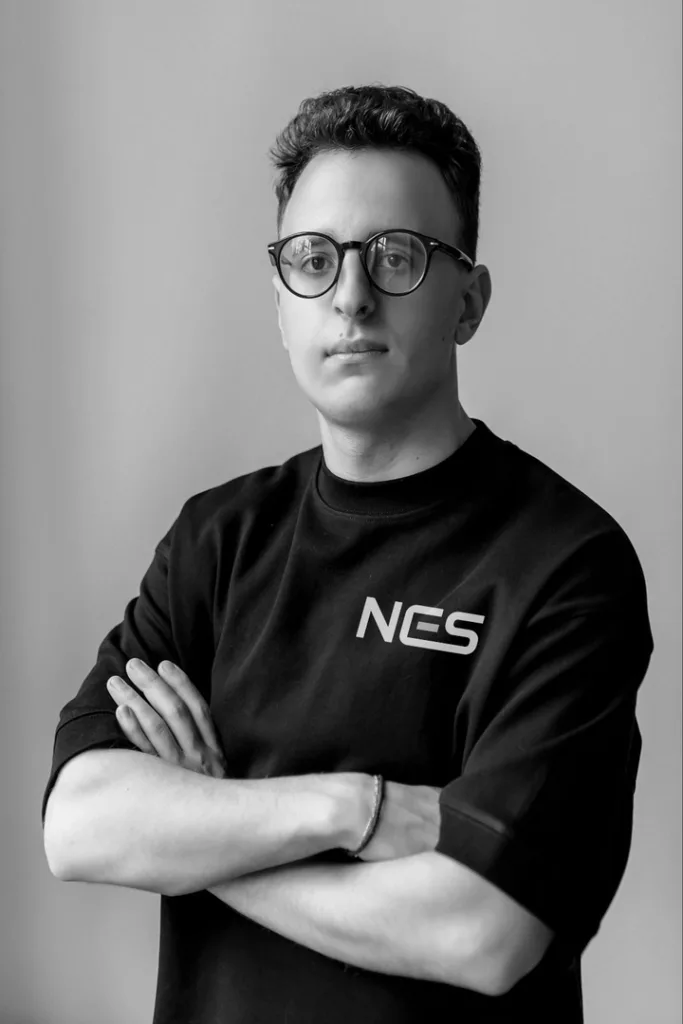 Oleksiy Kazavchynskyy, CEO: takes the first call, leads discovery and is your commercial contact. Merezha Prava's review describes working with "Oleksiy and his team".
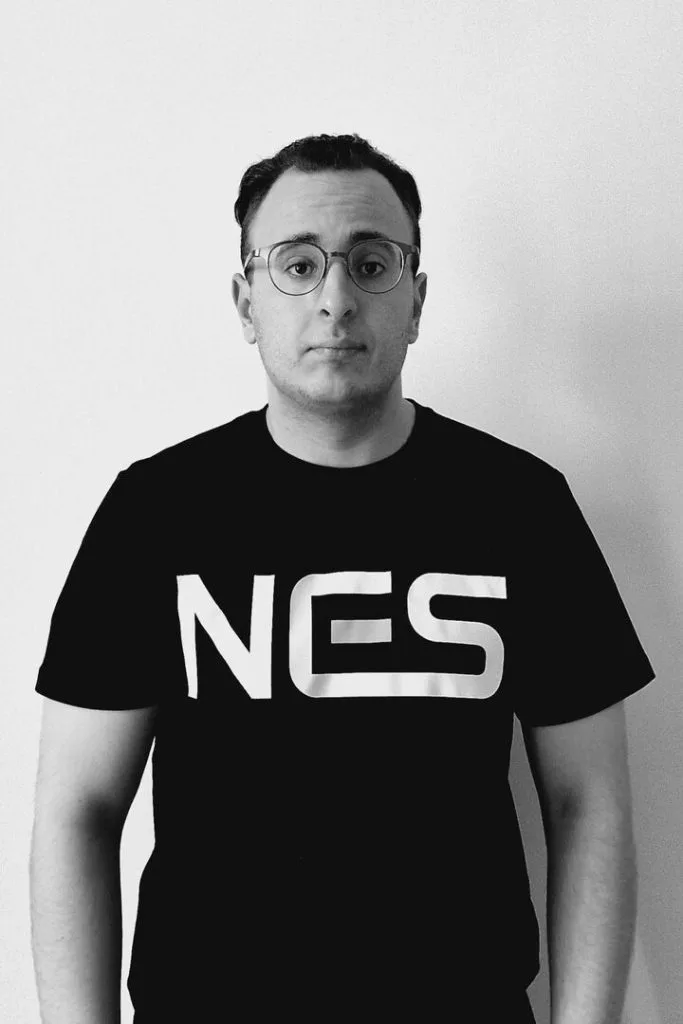 Andriy Kazavchynskyy, Co-founder, responsible for delivery; your staffing contact
- Dmytro, Business analyst and project manager
[TEAM SUPPLIES (review step): add "Reviewed by <name>, <date>" only after that person reviews the page]
FAQ
No. We also build shared-code apps with Flutter and Kotlin Multiplatform, and native Android. When an app needs deep iOS features, the iOS part is Swift either way. On the first call we'll tell you which fits your app and why.
Decide this before the first upload. The App Store shows the account's legal name as the seller. Some decisions belong to the Account Holder alone: only they can accept Apple's new EU terms (Apple). We have no single default; the agreement sets it. Often the app is published from your account from day one, as Merezha Prava's apps are. On some MVPs the account and keys sit on our side while we build, to move faster, and are then transferred to you. A company account costs US$99 a year. Apple asks a company for a D-U-N-S Number and a working website on its own domain. A sole trader enrols as an individual, and their personal legal name is shown as the seller (Apple).
Apple says it reviews 90% of submissions in under 24 hours, on average (Apple). A Screen Time app needs one more step first: Apple's approval of the Family Controls entitlement, which covers TestFlight too. Plan for that step separately (see Technical depth).
Yes. Rethought uses Apple's Screen Time frameworks and is live on the App Store. Know the limits first: Apple's approval before TestFlight, no access to app names, iOS 16 for adults' own devices, and testing on real iPhones.
Not through TestFlight. Until Apple approves the entitlement, we show the blocking on development builds on real iPhones. After approval, TestFlight builds work for your testers too. [TEAM SUPPLIES (engineer): confirm]
Yes. We built and ran Merezha Prava's apps for about two years. We start a takeover with our free high-level audit: what users say in your App Store reviews, the Apple rules your next update has to meet and, if you give us read access, your crash data. A 20-minute walkthrough and a plan you keep follow. The deeper checks of the code come once you hire us to fix, rework or extend the app.
With AppVanta OÜ, an Estonian company (reg. 17188835, VAT EE102858846). Next Era Solutions is a trading name of AppVanta OÜ. Your contract is with an EU company. The engineers who build your app work remotely across Europe.
How personal data is handled and transferred is agreed in writing for each project. Ask us about it on the first call.
Within one working week.
Tell us about your iPhone app.
What it must do, which Apple features it needs, and when you need it in the App Store.
Oleksiy replies within 1 business day.