 NextEraSolutions
Free mobile app audit: what your users run into, and what the stores will ask of your next update
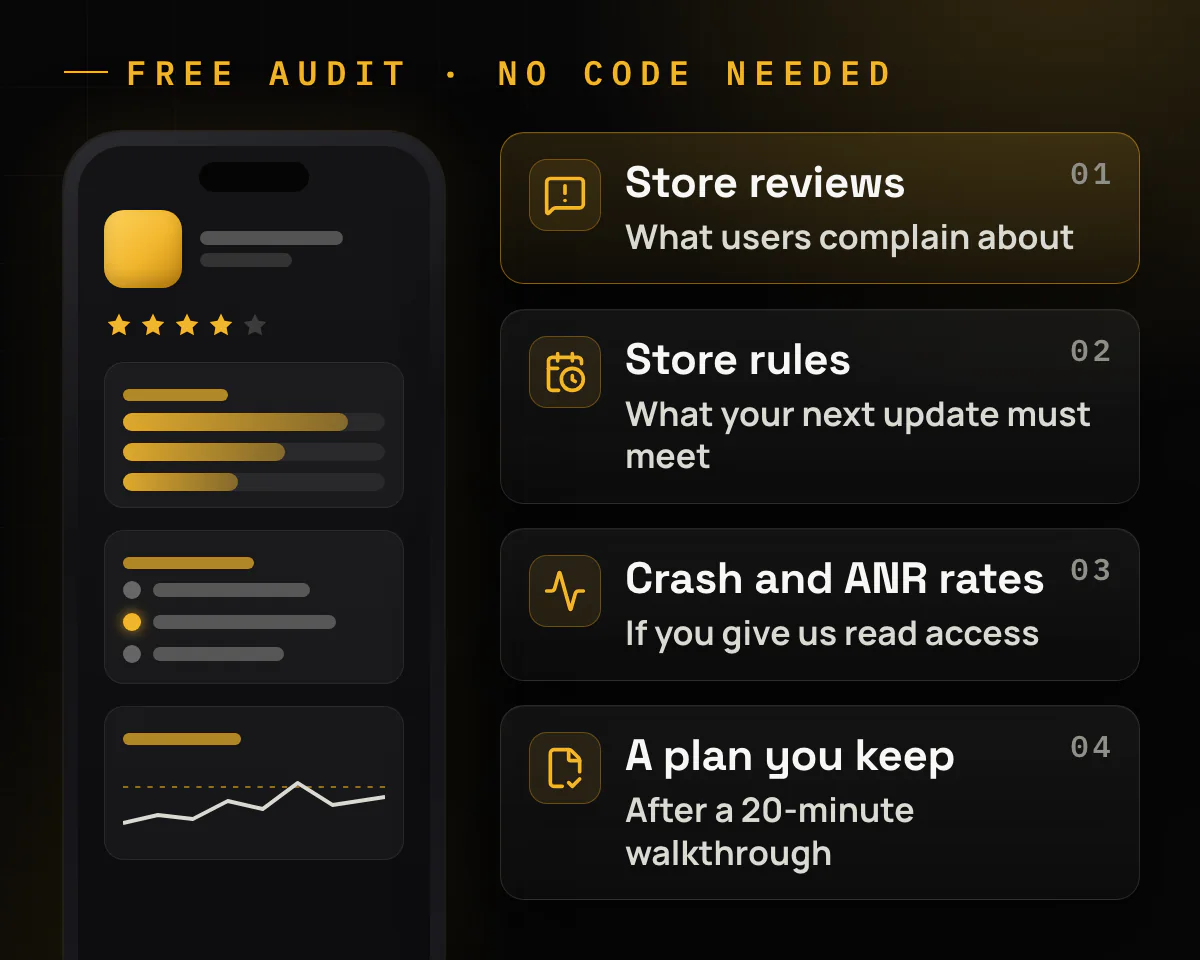
We fix, rework and extend apps that are already live. The first step is free: a high-level audit of your iOS or Android app. We read what users say in your store reviews, check the Google Play and App Store rules your next update has to meet, and, if you give us access, look at your crash data. Then a 20-minute walkthrough, and a plan you keep. Prefer to start from what you want to build next? Take a free consultation with our business analyst instead. It ends in a requirements document you keep.
Is this you?
Your rating is slipping.
The same complaints keep coming back in your reviews, and you want to know which ones to fix first.
Your app hasn't been updated in a while.
Google Play updates must now target Android 16 (API level 36), and the extension some apps got ends on 1 November 2026. From 1 February 2027, updates to apps targeting Android 15 or higher need 16 KB page-size support. App Store uploads have needed Xcode 26 since 28 April 2026.
Crashes or "app isn't responding" reports are rising,
and you want to know whether it's a few bugs or the foundations.
You inherited the app,
or the team that built it has gone quiet, and nobody on your side can say what state it's in.
You want to add to it.
New features, a redesign or an AI feature, and you need the requirements written down before anyone quotes.
What you get, free
- What users run into. The main complaints in your Google Play and App Store reviews, per store, in plain words.
- Where the app stands on store rules: which of the current Google Play and App Store requirements your next update has to meet.
- Stability, if you give us access: crash and ANR rates against Google Play's bad-behaviour thresholds, and the biggest crash clusters. An ANR is Android's "app isn't responding" message.
- A 20-minute walkthrough call on what we found and what to do first.
- A plan you keep. What to fix first and what can wait. Use it with your own team, with another vendor, or with us.
- Or: a free consultation with our business analyst. Dmytro, our business analyst and project manager, works through what you want to add or change. It ends in a requirements document you keep.
MobileVision
Our role: the engineering foundation behind releases.
MobileVision (clinical mobile workflows). We designed a full CI/CD flow and migrated the app's builds to it. Automated test runs and quality gates now check each build before every release. We fixed the client's test automation suite, including its batch runs, and set up testing on real devices in the cloud (BrowserStack, Firebase). None of the projects on this page was an audit. They show the release, stabilisation and platform work that follows one.
Read the MobileVision case →- 3 release layers: build, test and coverage
Stabilisation inside live products
Enterprise POS System · DACH food retail
Our role: Android engineers inside the client's core product team.
New features, stability work and ongoing support for more than a year, on a live POS system used by food retail businesses.
1+ year development and support500+ businesses supported
Read the case →Automotive Radio System · client under NDA
Our role: Android engineers brought in to strengthen a carmaker's radio module.
For 6 months we worked with the car's embedded devices and the automotive teams. Part of the job was making the hardware link and playback stable.
6 mo engineering engagement
Read the case →How it runs
| Step | What happens | When |
|---|---|---|
| 1. You get in touch | Book a call or email us the app's store links and what worries you. Oleksiy replies. | Within 1 business day |
| 2. We look at the app | Store reviews, store listings and the rules your next update must meet. Crash and ANR data too, if you give us read access. | Before the call |
| 3. Walkthrough | What users run into, where the app stands on store rules, and what to do first. | 20 minutes |
| 4. Your plan | Yours to keep. Fix it with your own team, another vendor, or us. | After the call |
- What we need from you: the links to your app on Google Play and the App Store. That's enough for the free audit. For stability data, read access to Google Play Console, App Store Connect or your crash tool helps. We don't need your code.
- Want to start from requirements instead? Ask for the consultation with our business analyst. You talk through what the app should do next, and you get a requirements document you can take to any team.
What it costs
- The audit is free. So are the walkthrough and the plan. There is no obligation to hire us.
- The business analyst consultation is free. The requirements document is yours.
- If you want us to do the work: we're paid per engineer, about $30–90/h depending on seniority and experience, under time and material, a fixed price, or outstaff. You get a written quote before any work starts.
- Not included in the audit: a penetration test or security certification (if you need one, we'll say so); an accessibility audit; legal or GDPR opinions; your backend.
What the free audit checks, and what comes next
What to check next on a live app
The free audit stays high level. If the app needs deeper work, these are sensible next checks for whichever team does it. The last column links a related case study.
| Area | What to check | Related case |
|---|---|---|
| Builds and releases | Whether the app builds from a clean checkout, and every manual step between merge and store. | MobileVision |
| Test data | Whether tests, test data or logs hold real personal data or live credentials. | MobileVision |
| Automated tests | Whether the tests run and can fail, not only whether they exist. | MobileVision |
| Offline behaviour | What the app does when the network or the backend is down. | Enterprise POS System |
| Connected devices | If the app talks to a device (a printer, a scanner, Bluetooth), how that layer handles a device that stops answering. | Automotive Radio System |
The free audit covers the three things under "What you get, free": what users run into, store rules (the Play target API level, 16 KB page sizes and the Xcode version for App Store uploads) and, with your read access, stability. It doesn't read your code. Code health, the build and release pipeline, dependencies, security basics, and who holds the keys and store accounts come after, if you want us to do the work. Every store date, with Google's and Apple's own pages, is in our 2026–27 store rules guide, linked below.
The plan you keep
It sets out what users run into, per store, and what your next update has to meet, and by when. With your access, it adds crash and ANR rates and the top crash clusters. Then it says what to fix first and what can wait, and lists your next-step options: your own team, another vendor, or us. What we didn't check is listed too.
Thresholds and deadlines we check against
Store dates and Android vitals last checked on 29 September 2026.
- Google Play stability thresholds. Google Play's bad-behaviour thresholds are a user-perceived crash rate of 1.09% and a user-perceived ANR rate of 0.47%, across all devices. Above them, Google says Play may make the app less visible and may show users a warning on its store listing. Android Developers, Android vitals
- Google Play target API. New apps and updates must target Android 16 (API level 36) since 31 August 2026. The extension some apps got ends on 1 November 2026. Google Play Console Help
- 16 KB memory pages. From 1 February 2027, updates to apps targeting Android 15 or higher can't be released without 16 KB page-size support. Android Developers
- App Store build tools. Since 28 April 2026, uploads must be built with Xcode 26 and a 26-series SDK. Apple, Upcoming requirements
- All the dates in one place. Our guide lists the Google Play and App Store rules in force on 1 October 2026 and what is due in 2027, each with its source. Google Play and App Store rules 2026–27
Who you talk to
An engineer per platform looks at your app, and a second reader checks the plan before you get it. Our engineers work remotely across Europe.
 First call, Oleksiy Kazavchynskyy, CEO. He takes the first call and is your commercial contact.
- Android audits, Alexey Kolisnichenko, Senior Android Developer
- iOS audits, An iOS engineer
 Second reader, Andriy Kazavchynskyy, Co-founder, responsible for delivery
- Requirements consultation, Dmytro, our business analyst and project manager. He writes the requirements document.
- Cross-platform apps (Flutter, React Native, KMP), In scope for the free audit. An Android engineer looks at them
FAQ
Yes. The audit, the 20-minute walkthrough and the plan cost nothing, and you don't have to hire us afterwards. We do it because some of the apps we look at need the kind of work we do: fixing, reworking and extending apps that are already live.
Yes. The free audit covers native Android and iOS apps, and cross-platform apps built with Flutter, React Native or Kotlin Multiplatform. An Android engineer looks at the cross-platform ones.
Quite a lot. Your store reviews show what users run into. Your store listings and the current Google Play and App Store rules show what your next update has to meet. With read access to Google Play Console, App Store Connect or your crash tool, we also look at crash and ANR rates. Code, build and architecture come later, if you hire us for the work.
On Google Play, updates must target Android 16 (API level 36); the extension some apps got ends on 1 November 2026. From 1 February 2027, updates to apps targeting Android 15 or higher need 16 KB page-size support. On the App Store, uploads have needed Xcode 26 since 28 April 2026. Our 2026–27 store rules guide has every date with Google's and Apple's sources.
Google Play may make the app less visible and may show users a warning on its store listing. That applies above its bad-behaviour thresholds: a user-perceived crash rate of 1.09% or an ANR rate of 0.47% across all devices. The audit compares your rates with them, if you give us access.
Yes. It's written so any team can act on it.
A free session with Dmytro, our business analyst and project manager, about what you want the app to do next. It ends in a requirements document you keep and can take to any team for a quote.
It depends on the people and the setup. We're paid per engineer, about $30–90/h depending on seniority and experience, under time and material, a fixed price or outstaff. You get a written quote before any work starts.
AppVanta OÜ, an Estonian company (reg. 17188835, VAT EE102858846). Next Era Solutions is its trading name. If you need an NDA before you share any access, say so on the first call.
Send us your app.
The store links, and what worries you: ratings, a store deadline, crashes, or what you want to add next. Planning a new app instead? Start with the app cost calculator or our MVP app development service.
Oleksiy replies within 1 business day.