

Short answer. Merezha Prava's clients follow their case, upload documents, see payments and lawyer comments, and get push updates. After launch, inbound calls fell by 15%, and 77% of users turned on notifications. In our own calculator's conservative legal scenario, though, the calls carry only about 9% of the payback. The rest depends on staff time and repeat work, which you should measure before you build.
Before the app
[TEAM SUPPLIES: OWNER CONFIRMS the client's OK to describe this workflow; asked in the combined Merezha message.]
Merezha Prava is a Ukrainian firm, and its clients used the chat apps common in Ukraine. They sent documents through Viber, Telegram and WhatsApp, sometimes all three in one case. A lawyer replied in another channel. People lost access to old numbers. Files didn't reach the CRM, so clients were asked for the same document twice (our founder's LinkedIn posts, 29 May and 4 Aug 2026).
The most common question was "What's happening with my case?", and the answer came by phone. With thousands of long-running cases, the information department spent much of its day on status calls.
If your firm swaps client documents over WhatsApp and email, the pattern will look familiar.
What we built
Our role: we ran discovery, designed the app, and built the native iOS and Android apps, the web admin and a modular Laravel backend with integrations into the firm's legal workflows.
- Phone-number sign-in with SMS verification.
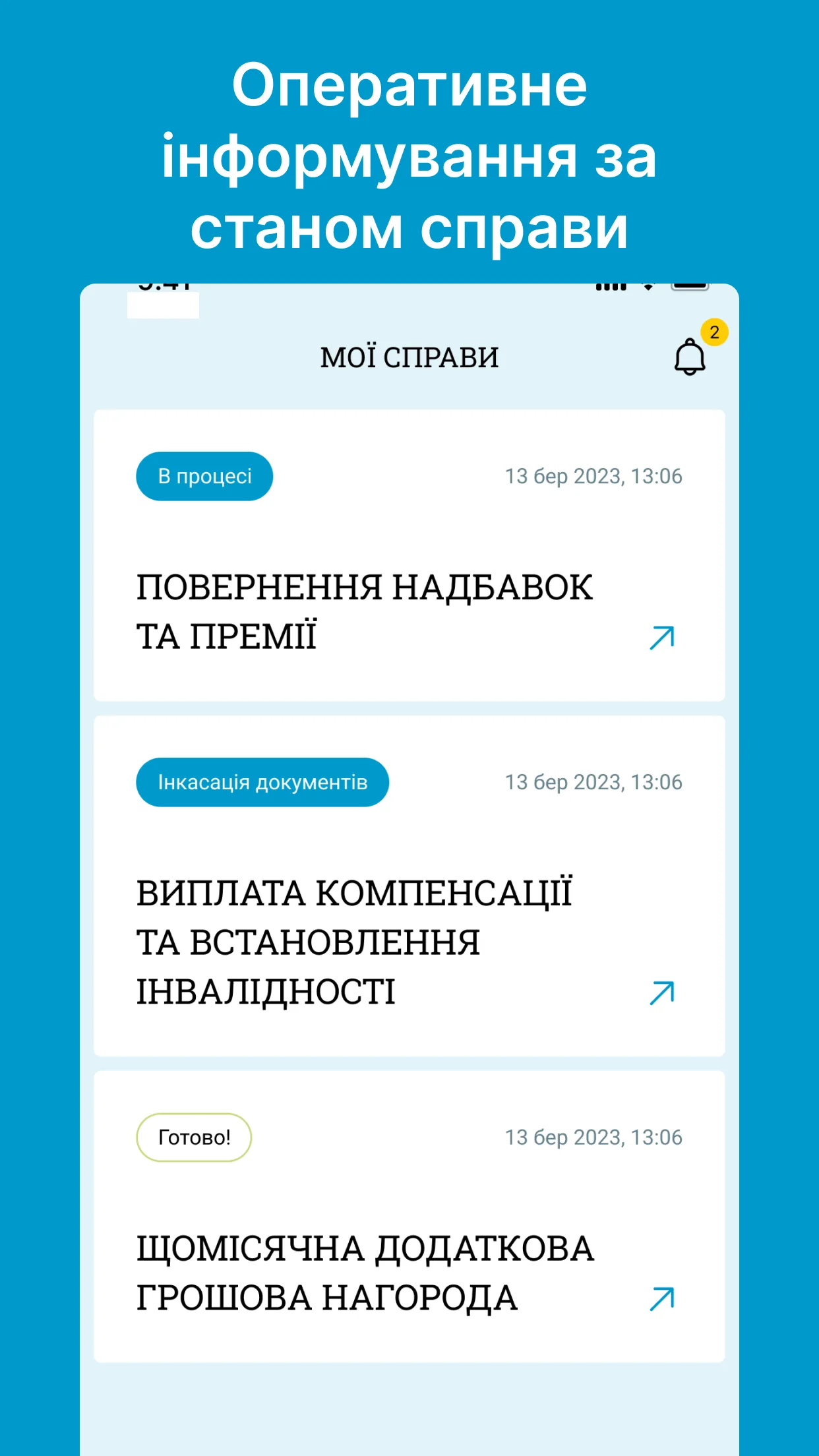
- A case timeline: stages, payments, documents and lawyer comments in one place.
- Push notifications for each stage of the lawyer's work, with deep links that open the client's own case.
- A catalogue of legal services, with requests made from the app.
- A community blog and an office map.
- A web admin and background processing for the legal team's daily work.
Stack: native iOS; Android in Kotlin with Jetpack Compose; Laravel, REST API, OneSignal, Firebase, CRM integrations. We would build it native again.
The first version shipped in 3–4 months, and we built and ran the product for about two years. The budget sits in the $50,000–$199,999 band.
[TEAM SUPPLIES: OWNER CONFIRMS the client is happy for the budget band to appear here.]
Where the 15% came from
The app tells clients when their case moves to a new stage. The notification opens the case itself: status, the lawyer's comment, the next step. That leaves clients less reason to phone. The 15% counts all of the firm's inbound calls, not only status calls.
Why 15% and not half? Some clients keep calling, and that is fine. Some can't use an app at all, because of age, digital skills or an old phone. The rest have to be brought across one by one. With tens of thousands of clients, that takes months, not weeks (our founder's LinkedIn post, 14 May 2026).
Nobody lost their job. The same team got back the time it used to spend giving the same answer by phone (his posts of 14 and 29 May 2026).
77% turned on notifications: three product decisions
We were told legal clients are privacy-shy and would switch notifications off first. In this app, 77% of users turned them on. We put that down to three product decisions.
- Every notification is about the client's own case, such as "your document was reviewed" or "your hearing date is confirmed". There are no "we miss you" messages. People keep bank alerts about their own payments switched on for the same reason.
- Explain first, then ask. No system prompt the moment the app opens. At first sign-in, a screen explains what the client will get and why: this is how you stop missing case updates.
- Ask once more, with the reason. When the app sees notifications are off, it offers to turn them back on, once, and shows what the client is missing on their case. Our founder thinks this step did the most. We did not measure each step separately.
For comparison, Airship's 2025 benchmark report puts the 2024 median opt-in at 59.5% on Android and 49.4% on iOS (p. 10). Android's median fell from 71.3% in 2023, because apps targeting Android 13 or later must now ask for permission, as iOS apps always have (p. 7). Airship recommends the same moves: a soft prompt before the system dialog, onboarding, and in-app messages to people who said no. It reports that those in-app messages lift opt-in among opted-out users by 14% on average (p. 12).
Notifications for follow-up services. We didn't design them for sales. After launch, the firm began grouping users by case type, status and group, and sending targeted follow-ups, for example that the next step needs a power of attorney. The rule stays the same: only messages about the client's own case.
[TEAM SUPPLIES: OWNER CONFIRMS the client's OK to describe the follow-up offers sent by push; asked in the combined message.]
Documents: an upload button instead of chat apps
Clients upload documents with a plain button in their profile. The document lands in the case. The lawyer sees it and comments in the same place. Nobody hunts for a compressed photo in a chat app or for the thread that had the passport.
For a law firm it is also a data question. Documents sit in the firm's own system, attached to the case, rather than in staff members' personal chat apps. In the first six months, clients uploaded more than 36,700 documents through the app (case study).
The ROI maths
Our ROI calculator counts three sources of return:
- Fewer calls: calls avoided × the cost of handling one call.
- Less admin off the phone: hours a week of status emails, chasing and data entry × the loaded cost of an hour.
- More repeat work: revenue from returning clients × the retention gain.
Payback = the build cost ÷ the monthly benefit. Maintenance (17.5% of the build a year by default) is shown separately, not inside the payback.
What one call costs in the UK
ContactBabel's 2024 guide to UK contact centres (225 centres) puts the mean cost of an inbound call at £5.58 and the median at £4.18 (Figure 5, p. 23). Our calculator uses the mean. ContactBabel itself notes that the median may be the truer picture of a typical operation, so if your office is small, try both. The same study puts the median service call at 6 minutes.
The calculator's legal template, conservative scenario
These are the calculator's default inputs for a legal or claims firm. The conservative scenario assumes the app removes 15% of simple-question calls. Merezha Prava's inbound calls fell by the same share.
| Stream | How it is calculated | Per year |
|---|---|---|
| Calls avoided | 700 calls a month × 15% × 12 = 1,260 calls × £5.58 | £7,031 |
| Admin time off the phone | 25 hours a week × £25 per staff hour × 52 | £32,500 |
| Repeat work | 800 inquiries × 12 × 20% become cases × £1,500 × 45% repeat share × 3 points | £38,880 |
| Total | £78,411 |
On a £150,000 build, payback is about 23 months. Add £26,250 a year of maintenance, and after three years the benefit only just beats the cost: a return of about 3%.
Look at the shares. The calls are about 9% of the benefit. Staff time is about 41% and repeat work about 50%. So the payback rests on the two numbers that are hardest to measure. Change one input at a time and watch it move:
| Change one input | Payback |
|---|---|
| Template as above | 23 months |
| Admin time 10 hours a week instead of 25 | 31 months |
| No admin time saved | 39 months |
| No retention gain | 46 months |
| Retention gain of 7 points (the base scenario) | 14 months |
| Median call cost (£4.18) | 23.5 months |
| Calls only, nothing else | 256 months (about 21 years) |
When calls alone pay for the app
How many calls a month you would need today for a 15% drop to repay the build within 24 months, from calls alone. Formula: build cost ÷ (24 × 0.15 × cost per call).
| Build cost | At £5.58 a call (mean) | At £4.18 a call (median) |
|---|---|---|
| £50,000 | ≈2,500 | ≈3,300 |
| £100,000 | ≈5,000 | ≈6,600 |
| £150,000 | ≈7,500 | ≈10,000 |
In hours, a 15% cut in the template's 700 calls a month is 105 calls, or about 10.5 hours a month at 6 minutes each. That is real, but small. The template's admin line assumes 25 hours a week. If you only measure one thing before you build, measure that.
[TEAM SUPPLIES, with the client's permission: Merezha Prava's real call volumes before and after, the size of the information department, and what the freed time went to.]
Does your firm need an app? Four signals
Our founder, Oleksiy Kazavchynskyy, checks four things before recommending an app to a law firm (LinkedIn, 5 May 2026):
- Cases run two months or longer.
- Hundreds of clients are active at the same time.
- Documents travel both ways: contracts, court papers, ID.
- Clients ask for a status update more than once a week.
His rule of thumb: two of the four signals mean an app is worth costing properly; with fewer, a better CRM plus a chatbot is the cheaper fix. Merezha Prava had all four. The maths above shows what an app might return in your case.
Know this before you start
- The app won't replace the phone. Some clients will keep calling. Plan for 15%, not 50%.
- Adoption takes months. The payback starts when most active clients use the app, not on release day.
- Cutting staff isn't the point. The value is the same team serving more clients.
- Notifications need a rule. Only messages about the client's own case; no "we miss you" campaigns.
What the client says
The project was delivered quickly and efficiently … they understood our needs with minimal guidance.
The full text of his review is on our home page.
[TEAM SUPPLIES: a short new client quote about calls or documents, if the client agrees.]
How we got these numbers
- Merezha Prava's figures come from our case page; the client counts them in its own systems. 36,000+ users counts accounts and installs; the 15% drop counts all of the firm's inbound calls; 77% is push opt-in; 36,700+ documents were uploaded in the first six months.
- The GBP maths is our ROI calculator's legal template, run on 23 Sep 2026; every derived number follows from the formula shown.
- Call cost and length: ContactBabel 2024, Figure 5.
- The push benchmark: Airship 2025, pp. 6, 7, 10 and 12.
- The three push decisions and the four signals: our founder's LinkedIn posts of 28 May, 25 June and 5 May 2026.
- The workflow before the app, adoption and staffing: our founder's LinkedIn posts of 14 May, 29 May and 4 Aug 2026; the client confirms.
Next step
- Run your own numbers in the ROI calculator. Start with the legal template, then replace the call cost, the admin hours and the retention gain with your own.
- Book a 30-min ROI review (below) and bring three numbers: calls a month, how many people answer them, and how long a typical case runs.
- Read the full Merezha Prava case study.
- See how we build a first version: MVP app development.
- What 50+ conversations with law firms taught our founder: 9 things legal firms taught us (his LinkedIn post of 13 Aug 2026).
- Why app ROI is mostly staff time: App ROI is the labour you stop paying for (his LinkedIn post of 11 Jun 2026).
- Price the build itself: app cost calculator.
- Why this app is native on both platforms: Native or cross-platform? How we choose.
- What a discovery phase gives you before the build: what a discovery phase delivers.